
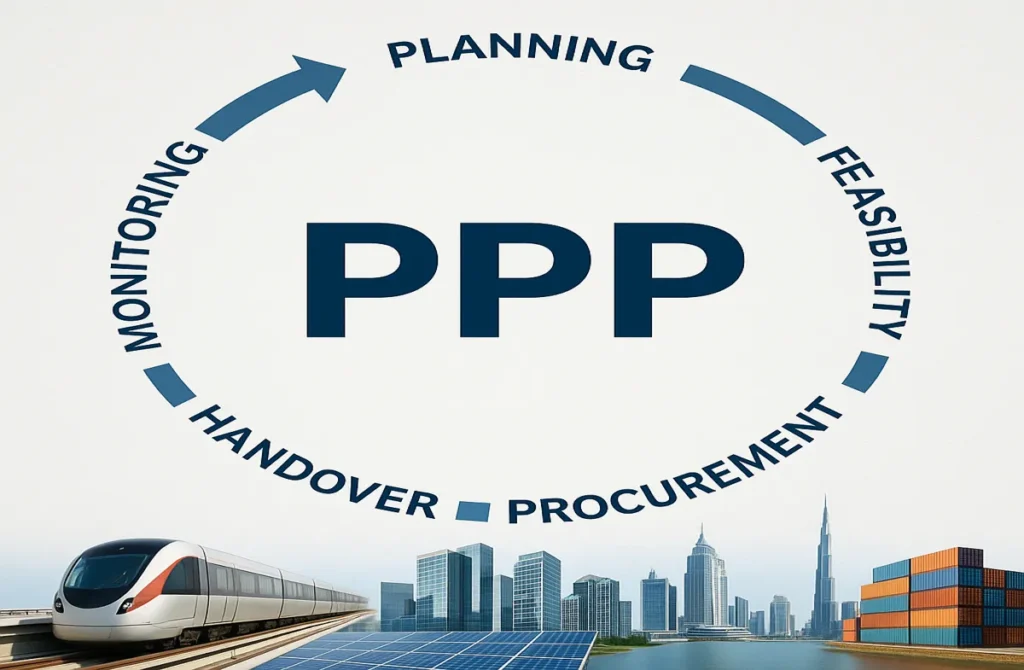
As governments worldwide seek innovative models to address infrastructure demands and service delivery gaps, Public-Private Partnerships (PPPs) have become a preferred mechanism—balancing public accountability with private sector efficiency. In the UAE, PPPs align with UAE national strategies enabling high-impact development while optimizing fiscal resources.
What Are PPPs and How Do They Differ from Privatization?
Public-Private Partnerships (PPPs) are long-term contracts between a public entity and a private party for the development or significant renovation and management of a public asset or service. In such arrangements, the private party assumes substantial risk and management responsibility over the life of the contract, provides a significant portion of financing at its own risk, and is compensated based on performance and/or demand. This model ensures alignment of interests between both parties. (APMG International, World Bank Group)
Unlike privatization, which involves the full or partial transfer of ownership to the private sector, PPPs retain public ownership while sharing operational risks and performance accountability. PPPs focus on collaboration, while privatization is a divestment model.
Global Best Practices in PPP Implementation
Internationally, effective PPPs follow recognized best practices:
- Establishment of clear legal and regulatory frameworks
- Transparent, competitive procurement processes
- Rigorous value-for-money assessments
- Balanced risk allocation and enforceable contracts
- Strong public oversight and performance monitoring
These principles ensure that PPPs deliver both economic efficiency and long-term public value (World Bank, 2017).
The UAE’s Approach and Methodology
The UAE’s PPP methodology includes strategic project selection, legal compliance at both federal and emirate levels, comprehensive feasibility studies, open tendering, and lifecycle performance management. Entities such as the Abu Dhabi Investment Office (ADIO) and Dubai’s Department of Finance play key roles in institutional coordination.
Priority sectors include smart infrastructure, healthcare, energy, education, and logistics—areas aligned with national development goals and innovation agendas.
How Impact Associates Supports Government Entities
At Impact Associates, we provide:
- Advisory and Implementation Support: We provide end-to-end support across the full PPP lifecycle—from project identification and feasibility, through structuring, tendering, and contract negotiation, to implementation, performance monitoring, and handover. Our multidisciplinary team brings expertise in law, finance, project management, economics, and governance. We ensure compliance, transparency, and value at every stage. More than advisors, we act as strategic partners embedded in your success.
- Capability Building: We deliver accredited training programs in partnership with APMG International, the global leader in PPP certification and developer of the CP3P framework in collaboration with the World Bank. Our programs go far beyond exam preparation—they offer a unique and immersive learning experience that combines international standards with real-world practice, equipping participants with the tools needed to lead and manage PPP projects effectively.
Impact Associates stands out not only for our technical expertise but for our commitment to empowering government institutions with practical, forward-thinking solutions tailored to the UAE’s development context.